

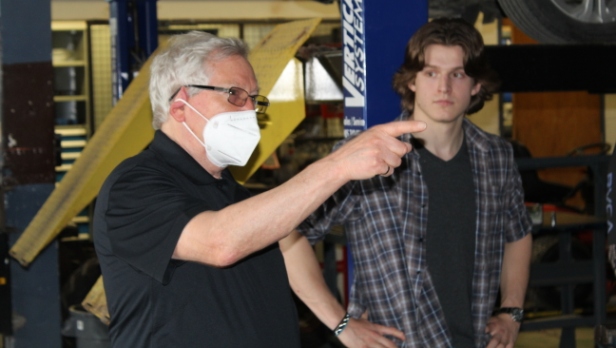
David Kuhnke, EVS Northumberland Chapter’s lead at CDHS with Jonah Herfst, Grade 11, Construction SHSM student
Skilled Trades Students Learn about Electric Vehicles (EV)
EV and Sustainability Event has been scheduled for May 28 at Northumberland Mall in Cobourg
Article/images by John Campbell
Campbellford - Climate change is real – and so is the need for humans to change as well, to prevent the world from becoming uninhabitable.
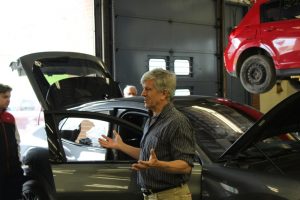
Steve Lapp
“We’re up against the wall … filling our atmosphere with carbon dioxide, so we have to change,” said Steve Lapp, a retired St. Lawrence College professor who taught renewable energy systems and building energy efficiency.
The “thin band of atmosphere (that surrounds earth) is critical for our survival. And if we fill it with carbon dioxide pass a certain point, we’re in big trouble,” Lapp said.
One way the threat is being addressed is society transitioning from vehicles that burn fuel to vehicles that run on battery power.
In a recent presentation to skilled trades students in Grades 11 and 12 at Campbellford District High School by the Electric Vehicle Society’s Northumberland Chapter, Lapp said “there will be areas of the world where people … will die because it’s too hot.”
Teacher Andrea Vanden Tillaart alerted Trent Hills Now about this special presentation to her students who are taking Senior Auto and Tech Design classes and Construction Specialist High Skills Major (SHSM) classes.
(Recent news reports pointed to the lives of millions being at risk because temperatures in parts of India and Pakistan had reached record levels; New Delhi endured seven consecutive days over 40 degrees Celsius.)
Climate change also means droughts, torrential rains, soil erosion – all of which will degrade the ability of countries to produce food.
Electric vehicles, which don’t emit carbon dioxide, won’t end the climate crisis but they’re “one of the key solutions,” Lapp said. People are switching to EVs “because we’re screwing up the planet, burning all the gas.”
The federal government has committed to requiring all new cars sold in Canada to be zero emission by 2035. In a news release issued in December, the government said: “Reducing pollution from the transportation sector is critically important, as it accounts for a quarter of Canada’s total greenhouse gas emissions—more than half of which come from light-duty vehicles (or LDVs), like passenger cars, sport utility vehicles, and pickup trucks.”
The number of electric vehicles on the road “is still relatively small, even though worldwide last year there (was) almost seven million” sold, Lapp said. In Ontario, “probably over 100,000” were sold, accounting for roughly 2 per cent of vehicle sales overall.
Electric cars sell for anywhere from $45,000 to $78,000, said David Kuhnke, EVS Northumberland Chapter’s lead, who also took part in the presentation.
The main misconception people have about EVs is their range and cost. Some might find them expensive to purchase but they’re far cheaper to operate and maintain than a gas-powered vehicle, he said.
It costs him one-tenth to charge his EV compared to what it used to cost him in gas.
When it comes to repairs, “there’s virtually none,” Kuhnke said, and maintenance is minimal.
“The battery will never need to be replaced,” during the car’s lifespan, he said.
As for range, it takes between eight and 20 minutes to charge a car to travel 200 kilometres, Kuhnke said, “so it’s pretty fast.”
It typically costs 30 cents a minute to charge a vehicle at a charging station.
He drove 360 kilometres and it cost him $2.75, he said.
The transition to electric vehicles will increase the draw on Ontario’s power grid by 2.5 per cent, but “it’s manageable,” said Kuhnke, a retired nuclear power engineer.
The province is preparing for that eventuality by adding small modular reactors at the Darlington nuclear generating station, and upgrading its hydroelectric system using new technology to better design turbines and generators.
The shift from fossil fuels to battery power is necessary because if the global average temperature continues to climb, it will be “an extinction event,” Kuhnke said. Humankind either changes, “or in a matter of 100 years we’re extinct.”
Lapp was asked about the environmental damage caused in mining minerals that make it possible for EVs to run, such as lithium.
Mining has an impact on the planet but it’s far less than making the climate worse in myriad ways, “which will make it impossible for literally billions of people to survive,” he said. The only way to get out of that is to not have a car,” which is impractical for people living in rural communities.
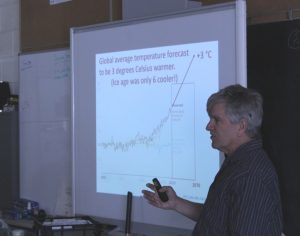
Steve Lapp making his presentation
“Even today, some people still think the atmosphere basically can just take whatever we give it and it’s going to absorb it all,” Lapp said. “But it’s not, it’s limited … We cannot burn all the carbon we have.”
“Climate change is not like other pollution.” It’s “the only one where the whole world is impacted so … the solution has to be everybody cooperating, and 190 countries have agreed to address climate change. It’s still going slower than it should but it is … happening.”
An EV and Sustainability Event has been scheduled for May 28 at Northumberland Mall in Cobourg. Up to 10 electric vehicles will be on display by owners and local dealers; four will be available for test drives.
The focus of the event, organized by EVS and Sustainable Cobourg, is to show how “electrification of the transportation system and other sustainable activities can help reduce humankind’s impact on climate change.”
To learn more about the Electric Vehicle Society visit https://evsociety.ca/northumberland.
Editor’s Note: Andrea Vanden Tillaart is a secondary school teacher at Campbellford District High School. She is also the lead for the Specialist High Skills Major program at the school, where she helps students explore career paths and gain important skills for the world of work. Before becoming a teacher, Andrea was a bank manager. She brings these real world experiences to the classroom, where she helps students experience all different kinds of success.


Leave a Reply