

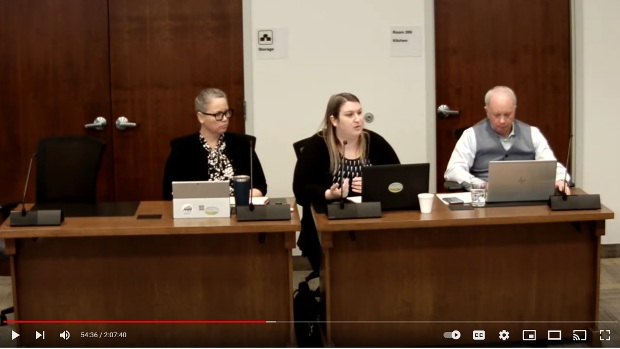
screen shot of Cristal Laanstra, manager of planning, centre, at council meet with Community Development Officer Kira Mees, and Director of Planning and Development Jim Peters.
Regulation Recommendations Not Coming to Council Until The Final Quarter of 2023
Municipal Staff say More Research Time is Needed before Implementing
“It is unfortunate we are having those few bad apple situations that do eat up a lot of time and resources.” Deputy Mayor Mike Metcalf referring to STAs in Trent Hills
Article by John Campbell
Trent Hills - Thurs., March 31, 2023 - Trent Hills lacks the resources to regulate short-term accommodations (STA) and needs more time to design a program that ensures changes to the Official Plan and zoning bylaw can be “appropriately implemented.”
Manager of Planning Cristal Laanstra raised the issue of “overtaxed resources” in a five-page report to council this week that recommended more research be done before any action is taken.
“Without (a) clear process and procured resources to assist in the implementation, the existing staff complement and software/programs may be inadequate for administering an STA program,” she stated. “Licenses will be become backlogged with no clear route to success at this time.”
Legal issues could also arise, “whether generally or site-specific for each property,” if short-term accommodations are established as a permitted use without appropriate standards and a compliance program in place, and adequate means of enforcement.
“This can also create financial risks as each legal issue requires significant resources to address,” Laanstra added.
“Based on (the) experience of neighbouring municipalities, the beginning of the program typically results in a large influx of applications … Without having an established process and resources to implement, licenses will be backlogged,” she wrote.
A “rushed process often results” in adjustments having to be made, which “is difficult with STAs as it can cause aggravation for those submitting applications expecting a clear, transparent process.”
Laanstra said “three pillars” — policy documents, a licensing bylaw with a set of standards, and compliance monitoring coupled with enforcement – are necessary for implementing an “effective” STA program.
The first pillar – amendments to its Official Plan and zoning bylaw – was introduced last May, and later updated after public consultation.
However, a compliance program with an enforcement component requires further work, as became evident in the feedback the public provided. Laanstra noted that typical STA programs have, at the outset, an application coordinator who accepts, reviews and monitors STA site plans, and enforcement staff who respond to complaints.
“Staff have reviewed current departmental capacity and are not able to provide the required service standard for applicants with existing staff levels,” she said, adding: “Current 2023 budgets do not include any additional staff allotments to accommodate the additional workload the STA program would create. Program delivery and full-time versus contract positions have also been discussed with no specific recommendation at this time.”
Laanstra further pointed out that the proposed licensing bylaw includes administrative penalties as they are “most efficient for gaining compliance and revenue to support” enforcement but a hearing officer is required to deal with appeals.
“This involves additional staff, workload, and planning to support the STA program,” she said.
Laanstra told council at its March 28 meeting that staff are looking to keep licensing fees “reasonable” for residents interested in providing short-term accommodations but they also need “to be enough to fund the program and to be able to employ extra staff that we need.”
The municipality could “put some policy documents in place” but that “would be premature when we don’t have any ability to actually implement the program.”
Council approved her recommendation that municipal staff continue interdepartmental discussions on designing a STA program and to bring back a progress report in the fourth quarter of 2023.
In the interim staff will look at bylaws currently on the books that could be used to deal with problems that STAs present. In her report Laanstra said the municipality has received over the past three years “an increasing number” of complaints related to noise, parking, garbage and “transient resident turnover.”
The rental of residential properties for up 30 days is not recognized in the comprehensive zoning bylaw and considerable staff resources are being used to deal with inquiries and complaints.
Mayor Bob Crate said he hears from some people “regularly about the fact that they can’t enjoy their property” because of an STA next door, and he asked Laanstra what can the municipality do to help them.
Laanstra said there might be “elements” in the nuisance bylaw that staff could start enforcing but Trent Hills has only one enforcement officer who’s assisted by personnel from other departments, and ”we’re doing as much as we can” to handle the existing workload.
Councillor Gene Brahaney, questioned why the municipality is even bothering to create an STA program.
“I’m yet to be convinced why we want to go down this road,” he said. People from outside Trent Hills who have purchased properties to operate as STAs have “no concern for the neighbourhood.” And they rent to people who are “yahoos” who “come in here for three days and destroy the neighbourhood,” staying in residences that could be rented out for six months or longer “to people who need housing.”
Brahaney said STA owner/operators were “sucking the blood out of (the) community.” They earn an “exorbitant amount” of money for a few days’ rental, “and we’re the ones that pay the costs” of enforcement.
“I don’t see that as being a money-maker,” Brahaney said. They’re “not the kind of tourists I want to see … People wouldn’t be allowed to carry on the activities they do at a resort or trailer park. And some of the activities I’ve heard go on (are) unbelievable,” even “obscene.”
Deputy Mayor Mike Metcalf agreed with Councillor Daniel Giddings that short-term accommodations are a “necessity,” as was spelled out in the report by Laanstra, who wrote: “Tourism is a continually growing economic driver” in Trent Hills, and Ontario’s Provincial Policy Statement “supports long-term economic prosperity by providing opportunities for sustainable tourism development through roofed accommodations.”
The availability of roofed accommodations in the municipality is currently “limited in meeting the needs of the travelling public,” she stated. “Therefore, STAs serve a purpose in addressing a gap for accommodation within the tourism sector.”
Metcalf said the municipality is trying to achieve “a balancing act” between providing affordable housing and encouraging tourism.
Laanstra said there are many short-term accommodations that aren’t a problem and are “really providing a service to Trent Hills.
“It is unfortunate we are having those few bad apple situations that do eat up a lot of time and resources.”


Leave a Reply