

MPP David Piccini
Local MPP Announces $13 million for Infrastructure and Financial Needs
Largest Amount Received from Government in Decades
Interim CMH CEO Eric Hanna said the “best case scenario” is that it will be seven years “before we move into a new hospital.” Until then “we have to keep on investing in this facility so that people feel safe and … we (can) provide the highest level of care that is there.”
Article/images by John Campbell
Ccampbellford - Mon., Feb. 6, 2023 - Until a new hospital is built, the province will continue to pour money into fixing Campbellford Memorial Hospital’s aging infrastructure and easing its financial pressures.
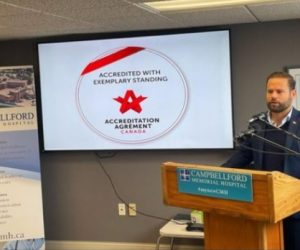
The latest infusion of funding, which Northumberland-Peterborough MPP David Piccini announced Feb. 2 at the hospital, adds up to more than $13 million – the largest amount the hospital has received in decades, he said.
Most of the money will be used to upgrade the HVAC system and to replace a generator, at a cost of $9,639,900. The hospital will also be reimbursed $1,874,929 for COVID-19-related capital expenses, and given $771,797 in COVID-19 incremental operating funding.
The province will further provide up to $600,000 in one-time funding to support the hospital’s in-year financial and operating pressures, $163,600 in pandemic prevention and containment funding, $81,132 through the Health Infrastructure Renewal Fund, and $46,884 in health human resources funding.
Those are huge sums of money to invest in a hospital that is seeking provincial approval to build a new one because the existing facility, which celebrates its 70th anniversary this year, is increasingly showing its age.
CMH began formulating an argument for a new hospital as far back as 2014 and a year ago it applied for a planning grant to have a detailed study done of what a campus of care would look like with a nursing home. A site has been secured on the west edge of Campbellford.
“Politicians and government don’t work as fast as we all want (them) to work,” Piccini acknowledged, “but over the past a number of months we have turned up the pressure … to get a planning grant for a campus of care.”
As a result of his efforts and those of the hospital board and Trent Hills council to convince the Ministry of Health and cabinet that a new hospital is needed, “we’re on everybody’s radar, and I’m very excited by what that means,” he said. “We’ve made a very strong case, to the ministry and I know as we engage in our multi-year planning process, you’re in everybody’s minds and, most importantly. in our hearts as well.”
Piccini said his party faces many challenges, in particular inflation, as it prepares this year’s budget, but whereas “previous governments have, for political expediency, made commitments (to) writing cheques that they couldn’t cash, the premier and this government (are) not going to do that.”
Still, he’s “very confident” that the “exemplary service” the hospital provides and the campaign he and the local community are waging on behalf of the project will push it across the finish line.

Interim CMH CEO Eric Hanna
Interim CMH CEO Eric Hanna said the “best case scenario” is that it will be seven years “before we move into a new hospital.” Until then “we have to keep on investing in this facility so that people feel safe and … we (can) provide the highest level of care that is there.”
Board chair Kevin Huestis said CMH over the past year has “made a concerted effort to enhance patient experience, raise quality of care, and make the existing hospital a satisfying place to work.”
Improvements have included the installation of a new nurse call system, renovations in the kitchen and dining room, and a “refresh” of the inpatient unit that included a much-needed paint job.

CMH Board Chair Kevin Huestis
CMH is also, with the help of the hospital foundation and the support of the community, investing in state-of-the-art diagnostic equipment, such as a bladder scanner and a digital slit lamp, Huestis added.
Hanna said the generator currently in use is more than 30 years old and has failed to start up “a couple of times in the past year” when there have been power outages.
The hospital received funding for its replacement last year only to discover more money was needed because the new generator won’t work with the hospital’s electrical system installed in the 1950s. That will cost close to $5 million to upgrade, he said.
Overhauling the HVAC system will be even more expensive but the huge investment being made is “not fixing everything,” Hanna said, just certain areas in the hospital, including the emergency department, lab and diagnostic imaging. To do more would cost another $10 million, he said.
Hanna said Piccini has “encouraged” CMH “to continue to make the renovations” that are necessary to keep the place open until a new hospital is built.
Like Piccini he is optimistic the “big final push” being made to get a planning grant will prove successful and that approval will “happen very, very soon.”
In the meantime the “biggest issue right now” is that the emergency department lacks a “negative pressure room” and there is an “insufficient number of private rooms” to handle another COVID-19 outbreak.
“There will be a submission that will go into the ministry in the not-too-distant future (about what must be done),” Hanna said. “We are better off than what we were but there still is a strong likelihood that if there is another outbreak … we will be asked to close again.”
Hanna said in an interview many more millions of dollars are required to address other “significant deficiencies” that studies have said are in “urgent” need of attention.
“We can reduce those costs if we know that we are … going to be moving into a new facility.”
Hanna pointed out the hospital plans “to submit another proposal for up to $15 million to renovate the emergency department.” The high cost “provides additional support and evidence” of just how “dire” the hospital’s condition is and why its redevelopment is vital.
The improvements will not necessarily add to the hospital’s value when it comes time to dispose of the property because “there’s very, very limited use for the current building.” He offered as an example physical constraints that inhibit it being converted to supportive housing.
His experience tells him that “in selling used hospitals you’re not getting rich off it, “ he said. “It’s really just …tear it down and turn it into a condominium or something like that. But that hasn’t been explored yet,” because the timelines aren’t known as to when a new hospital will get built.
With the latest funding announcement, the province has invested more than $16 million in recent years to bringing the hospital up to standard, “money you’re not going to get back,” he said, but it needs to be spent to keep CMH running.
Leave a Reply