

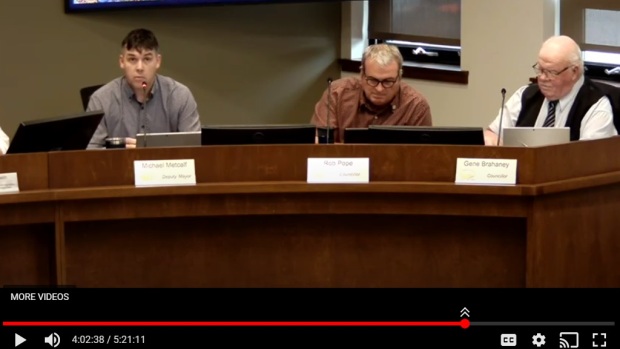
Screen shot Nov. 22 council meeting, from left, Deputy Mayor Mike Metcalf, Councillor Rob Pope, Councillor Gene Brahaney.
“I’ve renamed Bill 23 Bulldozer 23.” Councillor Gene Brahaney
The Bill’s Ramification, if Passed, Discussed in Terms of Cost to Municipalities, Taxpayers
“Taking that revenue source out of the municipality to be able to put back into infrastructure for all that new development just seems ludicrous to me and doesn’t seem like it was thought out.” Deputy Mayor Mike Metcalf
Article by Sue Dickens/Image Screen Shot of Council Video
Trent Hils – The Ford government’s Bill 23, “More Homes Built Faster Act,”, if passed, will have a huge monetary impact on municipalities throughout Ontario, including Trent Hills.
In a report to council at their meeting on Tuesday, Director of Planning and Development Jim Peters wrote about the potential costs that could be created by the proposed changes.
Peters told council, “This bill, along with many others that the province has put forward is probably making some of the most substantive changes we’ve ever seen to planning and development in the province. And because we at the local level are the approval authority, we’re going to be the ones that are feeling the impacts of these changes.”
He points out there are proposed changes to the Conservation Authorities Act which would limit the role of Conservation Authorities (CA) to comment on planning applications. The changes also prohibit CA’s and municipalities from entering into agreements whereby they can provide certain services to the municipality.
In his report Peters points out that currently Trent Hills has service agreements with Lower Trent Conservation (LTC), and Otonobee Region Conservation Authority (ORCA) to provide Planning Review services. Especially important are on-site evaluations of wetlands, review of Environmental Impact Studies and Stormwater Management Plans. Without these services being available, municipalities will have to undertake the work themselves and will require the applicant to pay for a third-party review. This will likely result in both a slower and more expensive review process.
Public Participation is also proposed to change with respect to the planning process.
There will no longer be a requirement to hold a public meeting for an application for Plan of Subdivision, only to carry out a public circulation. Another major change is that third party appeals will no longer be possible to the Ontario Land Tribunal. Only the applicant and certain prescribed bodies such as Utility companies will be able to make appeals.
There is much more in terms of what Bill 23 will impact if it is approved and it can be found in the report presented by Jim Peters.
He told council, “Major impacts are if we don’t have the ability to rely on the conservation authorities and the agreements we have on with them to provide information and answer questions and provide certain services, that burden is going to either come on to municipal staff or we’re going to say to the applicant, you’re going to have to get a third party consultant to answer and provide that information.”
He noted there are “also significant changes to how we deal with heritage matters.”
Deputy Mayor Mike Metcalf spoke about the problems he sees with Bill 23, “I know currently sitting on the Otonabee Region Conservation Authority I got a lot of information regarding this in the last little while. It is very troublesome on many aspects.”
He also challenged the way the Bill was brought forward.
“Many people find it very deliberate that the first reading of this came out on October 25, the day after a municipal election, knowing that municipalities aren’t in any order to make comment quickly on the matter. Second reading came out six days later. If anyone wants to tell me that that wasn’t a deliberate timeline I’ll challenge that.”
Commenting on the “widespread planning changes,” he noted, “development charges growth is supposed to pay for growth.”
Metcalf pointed out that the costs of housing will fall onto residents, because of this Bill. “I mean, if you look and you read all the documents that are with this report, I don’t know how many times that’s alluded to is that growth pays for growth if growth doesn’t pay for growth your neighbor is paying for the subdivision. …the residents of each municipality is paying for that housing development and not the developer that could potentially be profiting a lot from those development builds. Putting that onus on the back of the residents of a municipality is not something that I would be in favour of.”
He also questioned the information the province is receiving that says development fees are hindering development growth of new homes.
“I don’t think we have seen it here, that any development charges are hindering developers for coming and wanting to build you know, correct me if I’m wrong but taking that revenue source out of the municipality to be able to put back into infrastructure for all that new development just seems ludicrous to me and doesn’t seem like it was thought out.”
He spoke of how the province seems to be taking powers away from municipalities.
“This is coming on the back of what we saw when Bill 3* come through … which is a complete attack on municipal democracy. I mean, back to back, it just seems like the province is wanting to take the power and the powers that have been given to the municipality to determine how they’re going to grow away from them.”
Councillor Gene Brahaney spoke about Bill 23 and and said, “I’ve renamed Bill 23 Bulldozer 23.”
He added, “Go back two years ago before the election, Premier Ford seemed to have this agenda that he was going to torpedo conservation authorities, even though it was his conservative government that brought their creation in 1943 or ’44.”
Brahaney noted, “I think people have reached their frustration level…even on television last night, the former mayor of Toronto, who was the chair of Conservation Ontario, and he had resigned from that, he’s still got an ear on to this and he’s leading the demonstration I believe at Queen’s Park.”
Today it has been reported, that the Prince Edward County Field Naturalists, joined by other local environmental organizations, will meet at Bay of Quinte MPP Todd Smith’s office to protest the Ford Government’s Bill 23, More Homes Built Faster Act. All members of the public were urged to join the protest.
Brahaney added, “Now he (Premier Ford) wants to take away the last little bit of consultation we have about water and drainage and stuff to operate.”
Councillor Dennis Savery added his comments also at the council meeting stating, “Bill 23 is bad policy…I’ve been in real estate for 28 years and circumventing and speeding up the process could mean possibly having regrets and lawsuits in the future because we didn’t do our due diligence as the Council or the planning department was cut short on time because they were rushed through the process. It could backfire on everybody… the conservation authorities are there for a reason.”
Savery added, “This legislation would be nonproductive in this sense and in the long run, it’s going to do more damage than it’s worth.”
Once again Deputy Mayor Metcalf spoke to council talking about the reduction of Conservation Authority input to development decisions by the municipality and what it could mean.
He asked, “What’s going to be the future costs to the municipality because as of right now, we still have to get that planning information that our conservation authority gives us so we have a memorandum of understanding to get that professional opinion.”
He also raised this question. “What’s the future liability on the municipality and the council when we don’t have that professional opinion and we’re approving a build, a development and we don’t understand what the future of that development consequences are of putting a development in that area.”
He added, “I understand that we need to build houses and get that whole (lack of affordable) housing situation cleared up but this is not going to be the way to do it and I think we’ll see consequences 10, 15, 20 years down the road when things were rushed through just because we need a house. And then we’ll be in that same position 20 years from now when they were built in the wrong spot.”
He added, “So all of this to me is backwards and it’s not taking us forward in a prudent way.”
The Mayor concluded the discussion by saying, “Well, I think with this resolution, we’re actually voicing our objections. And as the deputy mayor said, we may want to ask our own staff to add a letter to this to make sure that our thoughts are heard.”
The motion before council was approved and with it the decision that staff be directed to support and reiterate the comments provided by Northumberland County, and Eastern Ontario Conservation Authorities. And that comments also be submitted regarding the potential costs that could be created by these changes.
The full text of the comments by the County and Conservation Authorities are included in the complete agenda of council’s meeting Nov. 22 which can be found online.
The Globe and Mail has made this statement about Bill 23 which might provide some more clarity: “The Ontario government is amending parts of its sweeping draft legislation aimed at speeding up housing construction, but critics say the move does little to fix the bill, which they charge would shift billions of dollars in infrastructure costs now covered by developers to municipalities and weaken environmental oversight….Among the adjustments is the withdrawal of a proposal that would have banned all “third-party” appeals, such as those launched by residents or environmental groups, of projects before the province’s land tribunal.”
*Bill 3 - The Government of Ontario today introduced the Strong Mayors, Building Homes Act, a Bill that would, if passed, alter the governance and public administration of the cities of Ottawa and Toronto by providing the mayors of both cities with new powers. Source Strong Mayors, Building Homes Act | AMO
About Bill 23 as presented by Jim Peters in his Report
Proposed changes to the Planning Act will permit up to three (3) dwelling units as a right on any property currently zoned to permit one (1) or two (2) units for any parcels of urban residential land in settlement areas with full municipal water and sewage services.
Bill 23 has also initiated a housing-focused policy review of A Place to Grow and the Provincial Policy Statement. The Province is seeking input on how to create a streamlined province-wide land use planning policy framework. This may mean that both the existing policies are replaced by one new policy.
Proposed changes to the Ontario Heritage Act will require that all properties on the Municipal Heritage Register must be considered for designation within two (2) years or be removed from the Register. There are also limits on how soon a property may be reconsidered for designation. As well, properties or Heritage Districts being considered for designation must meet a minimum of two (2) of the criteria set out in the Regulation.
Comments provided by Watson and Associates, as well as the Association of Municipalities of Ontario, identify costs to municipalities due to many of the changes. Watson especially focuses on changes being proposed to the Development Charges Act. There changes are aimed at affordable and attainable housing units. However, the changes appear to reduce the income available to provide growth related infrastructure and fund affordable housing.
The complete information can be found in the agenda for the Nov. 22 council meeting.
Background:
Bill 23, the More Homes Built Faster Act was introduced and given first reading by the Ontario Government on October 25th, 2022, passing second reading on October 31, 2022. It is currently at a Standing Committee with public hearings scheduled.
Bill 23 proposes to amend numerous pieces of legislation in order to increase housing supply within the province. There are numerous impacts that will be felt at the municipal level. Commentary and review of the Bill have been provided by the Ontario Professional Planners Institute, the Association of Municipal Clerks and Treasurers, the Association of Municipalities of Ontario and Conservation Ontario.
On November 10th, 2022, Planners from Municipalities and Conservation Authorities across Northumberland County met virtually to discuss possible implications and the timeline for comments. The deadline for comments on most of the proposed changes is late November or early December.
Northumberland County Council considered, and approved, comments prepared by staff; the submissions at its meeting of November 9th, 2022.
Editor’s Note: According to Niagara Falls Council Bill 23 will put the cost of development on the back of taxpayers, result in the loss of environmental protections, heritage conservation and accountability to the public.
Leave a Reply