

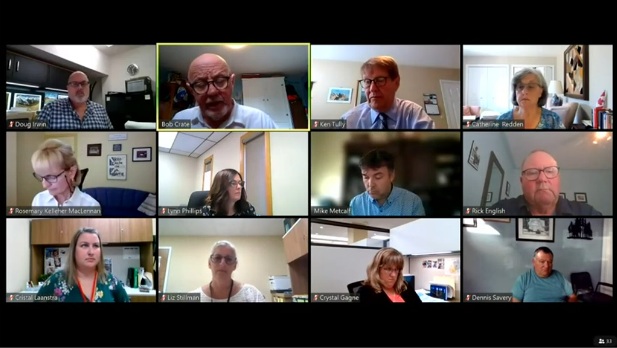
Screen shot of public planning meeting by Trent Hills Council
Comments Heard at Public HearingShort-Term Accommodations Not a Permitted UseStaff will likely deliver an interim report to the current council but “final changes will probably come after the election” on Oct. 24. Article by John Campbell Trent Hills - There are two sides to every story, and Trent Hills council heard both of them this month at a public hearing held to receive comment on measures the municipality has proposed to regulate and license short-term accommodations (STA). Several residents argued strenuously in favour of them being banned, saying they disrupt neighbours’ lives, while those on the other side of the issue insisted there are bylaws already in place to deal with the few “bad apples” whose boorish behaviour is tarnishing the reputation of a fast-growing segment of the travel industry. Bea Soffers said short-term accommodations have proved to be a “nuisance” in “a lot of communities” and she worried that allowing them to gain a foothold in Trent Hills “will lead to commercialization, particularly in desirable locations, such as waterfront property.” Short-term renters “don’t have a vested interest in the community, and that is where my problem lies,” she said. They haven’t “an understanding of what type” of community they’re staying in, “and this is bound to cause issues.” Christine MacGregor and her father, Don Clarke, rent out properties as short-term accommodations, and “all the neighbours love it,” Clarke said. Trent Hills currently has no policies governing short-term accommodations and they are not listed as a permitted use in its comprehensive zoning bylaw. Municipal staff have proposed amending the Official Plan and zoning bylaw to provide a framework for setting policies and regulations. They’ve also drafted a licensing bylaw designed to ensure STAs are operated in an appropriate manner. The proposed regulations include establishing a maximum number of guest rooms (3), limiting the number of guests per room (2) and the number of licences an individual could hold, and allowing for licences to be revoked for violations of the licence agreement. The regulations would apply to dwellings rented out for 30 or fewer consecutive calendar days. Fines that go unpaid would be collected through property taxes. John Keeting had nothing good to say about the “partiers” who rent the house next to his in Campbellford. They spend the night “drinking, smoking dope, and just having a grand old time. It’s upsetting,” he said. Since he reported the problem to the municipality, it’s “got three times worse so I’m really at my wit’s end.” Neal Solomon said he’s had to deal with “foul language (and) loud music … from early in the morning until late at night.” Christine Quinn said the Airbnb next to her home in Hastings is “the absolute worst,” as renters “party until dawn,” are “really noisy” and are “completely disruptive to the area.” One STA property owner identified as Govin said his clients sign a contract and “know the rules before they go in there.” Of the 20 to 30 people who have rented his waterfront property, there’s been only one incident where he’s had to evict renters for being loud and “pissing off” neighbours. Andrew Arklie said he spent nearly $100,000 locally to renovate a cottage near Hastings and he’s received more than 200 five-star reviews on his Airbnb page since he started renting it out five years ago. In her presentation at the hearing held Aug. 2, Cristal Laanstra, the municipality’s manager of planning, said “skyrocketing housing markets (have) contributed to an increase in rentals as home ownership is often only possible in some instances when additional income can be made. This has resulted in a use beginning prior to policy frameworks being established, where planning and regulation become reactive. This creates a bit of a tricky situation for the municipality when we are required to respond.” Trent Hills is “at the beginning of the process” of putting together a solution, she said, and staff “will continue to undertake stakeholder consultation” as well as receive comments from the public. The municipality’s Director of Planning Jim Peters said in an interview that staff will likely deliver an interim report to the current council but “final changes will probably come after the election” on Oct. 24. He estimated there are “around 100 or so” properties in Trent Hills being rented out as short-term accommodations. Trent Hills is “following the same path that many other municipalities” have taken in response to STAs, devising policies and regulations that say “here’s the way it needs to be done,” but as with “any trending planning issue … it’s often a challenge.” A “lot of people say you should say no,” he said, “but we’re still going to have to do something to address it no matter what.”
|


Leave a Reply