


When It Comes To Solutions For Dealing With Homelessness & Drug Addiction
Article & Images by Valerie MacDonald News Now Network
Substance abuse, mental health and chronic homelessness are intertwined issues that present a problem not just for cities, but for smaller communities.

Cobourg Mayor Lucas Cleveland
At its most recent council session, Northumberland County’s seven county councillors, including Cobourg Mayor Lucas Cleveland, passed a resolution “not endorsing the operation of any unsanctioned overdose prevention sites in Northumberland County.”
In addition, councillors directed County staff in another resolution to “collaborate and support the (local health unit) on a community needs study and feasibility assessment for a sanctioned consumption site….including appropriate and immediate responses and long-term solutions for consumption services that comply with local, provincial and federal laws.”
The pair of resolutions passed April 12, follow volunteer pop-up overdose prevention sites in Peterborough and Cobourg. Unsanctioned in Cobourg, a site popped up in various places run by concerned volunteers wanting to provide a safe place for drug consumption.
Last month, in response to the operation, Cobourg council passed a resolution: “Council urges that the Organizers wanting to create this space to follow the legal process to operate a supervised consumption site (SCS) as approved and licensed by Health Canada who may grant exemptions for an SCS after satisfactory completion of an application which includes consultation with a broad range of people in the community.”
Because substance abuse is often interconnected with homelessness and mental health problems, some county and area residents have banded together to suggest housing solutions because they believe government, at all levels, is not moving quickly enough. Delegations have made the case for launching a Tiny Homes project. Its goal to get homeless people off town streets and away from living rough in tents and cars.
When asked about what responsibilities and mandates the County and Cobourg have to deal with these matters, the County’s director of communications Kate Campbell said there is a recognition of the need to deal with substance abuse problems in the community and that the County is working with its partners and other levels of government to meet those needs. Towards that end, Northumberland County’s funding for affordable funding has more than doubled with $500,000 put into this year’s County budget to combat homelessness, she said.
The problem, Campbell said, is that counties and municipalities lack the resources, both in experience and in funding, to deal with these matters, including difficult problem of chronic homelessness.
“We need an integrated solution” here and across the Province, Campbell stressed during the wide-ranging interview. “Municipalities alone can’t close the gap.”
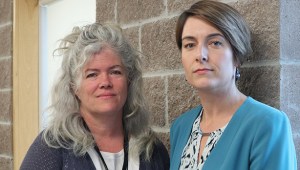
(L-R) Lisa Horne & Kate Campbell
At this time, Northumberland County Community & Social Services director Lisa Horne and Campbell both say the County is working with the Haliburton, Kawartha, Pine Ridge District Health Unit (HKRP) which has the lead with regard to “health care, mental health and harm reduction/addiction services.”
In addition, Horne says there are two Northumberland Hills Hospital outreach workers helping those who are “unhoused” and needing mental health and addiction services- positions funded by the County.
The understandable intercession of private citizens concerned about consequences of drug overdoses and the lack of housing, nevertheless has led to reactions from local politicians and some downtown Cobourg businesspersons.
Cobourg Mayor Cleveland told the News Now Network he doesn’t support unsanctioned overdose prevention sites and voted along with the County Councillors who recently voted in favour that resolution.
He said his role as mayor of the town is to “be compassionate and understanding” while supporting the existing agencies that are “proven effective and efficient” in helping people “move along the continuum to recovery.”
Cobourg has no staff committed to housing or substance abuse and “Cobourg’s responsibility is not in social services,” he stressed while noting that when he first took office he sought legal advice about the areas of the town’s responsibilities. As it relates to building, it does have responsibility for infrastructure like roads and bridges and it may, if council decides, take steps that lower costs for affordable housing builders – but council is “not able to address homelessness, per se,” Cleveland said.
For that reason, Cobourg can’t partner with Tiny Homes for example, although the County could, he said.
“We can’t duplicate services.”
These services include County social services programs like: rent geared-to-income supports, managing county owned affordable housing, building new affordable housing per the 40 units under construction at Elgin and D’Arcy Streets in Cobourg, and the Memo of Understanding partnership with Habitat for Humanity and the Ontario Aboriginal Housing Services to build 62 affordable housing units at 473 Ontario Street – both in Cobourg – where the housing wait list shows there is the greatest need in the County.
“Housing Services is the Consolidated Municipal Service Manager for housing initiatives, responsible for systems-based planning for housing throughout the County and leads strategic initiatives relating to housing stock, affordability, viability, and housing security mandated by the provincial government and according to County strategic priorities,” states an overview prepared by Northumberland’s Community & Social Services Department.
“Housing Services also leads the implementation of the Northumberland County Affordable Housing Strategy and is a co-lead alongside Community Services for the Ten-Year Housing and Homelessness Plan with a joint commitment to Housing First and providing housing stability for individuals across the housing continuum. This commitment along with the Ten-Year Housing and Homelessness Plan and the Affordable Housing Strategy provides guidance and direction for the division. Housing Services is also responsible for the implementation of the forthcoming Community Housing Master Plan,” the overview states.
“Housing Services is specifically responsible for the administration of Community Housing programs and non-mandated affordable housing programs in the County to ensure housing providers and other housing system stakeholders are meeting obligations in compliance with Social Housing legislation, County policies, municipal standards, and various operating agreements. In addition, Housing Services is responsible for the oversight of the Purchased Services Agreement across County departments with the Northumberland County Housing Corporation (NCHC). Housing Services works to implement the strategic vision of the NCHC Board of Directors while implementing housing retention models of community housing. Housing Services plays a key role in the implementation of the NCHC 2023-2027 Strategic Plan.”
See the following site available for housing and shelter assistance through the County and other agencies at: https://www.northumberland.ca/en/living-here/housing-and-shelter.aspx
The County also chairs the Homeless Community Response Table called the Homelessness Coordinated Response Team. It includes the police, Greenwood Coalition, the Salvation Army and the Cornerstone Family Violence Prevention Centre located in Cobourg, Horne said.
Through Ontario Works, the County provides assistance through provincial childcare subsidies and food security through $1.3-million annually in funding and operating the Food For All Warehouse which in turn supports 120 food programs throughout Northumberland.
Partnering with Habitat for Humanity’s support program also helps people stay in their homes by financing repairs to roofs or improving heating systems of privately owned residences, for example.
There have also been several meetings between County staff with the Sleeping Cabins Collaborative “to learn more about their project,” Horne said, but Campbell added the County doesn’t have any “appropriate properties” for such a project which needs water and sewer services.
“We haven’t talked to Tiny Homes,” Horne added.
County Council has not received any delegations about building small homes for the homeless, Campbell said. There is the emergency shelter, Transition House, on Chapel Street in Cobourg.
There are also various other “tables” like these dealing with chronic and interrelated issues, Campbell said. These include those on homelessness, poverty, substance abuse and mental health and participants include Cobourg. Mayor Cleveland said he was just going into that community committee as the recent interview with the News Now Network was concluding.
The local health unit made a presentation to County Council on April 12 and its Medical Officer of Health Dr. Natalie Bocking offered this overview of responsibilities as it relates to substance abuse.
“The Haliburton, Kawartha, Pine Ridge District Health Unit supports collaborative evidence-based approaches to minimize the risks and harms associated with substance use. This strategy involves the community and partners including people with lived or living experiences, health, social services, education, police, justice, and emergency services.”
“Together, we all strive for a supportive and safe environment that promotes the health and resiliency of individuals, families, and communities, and reduces the harms and stigma associated with substance use.”
“We recognize that communities cannot do this alone and strongly recommend that all community partners work together to support people who use substances.”
 The County’s Housing and Homelessness plan can be viewed at: Northumberland County Housing and Homelessness Plan 2019-2029
Editor’s Note: Reporter Valerie MacDonald has emended her article after discussions with Northumberland County’s communications director Kate Campbell.
“Municipalities that lack the resources, expertise and funding to deal with complex health care issues that are contributing to chronic homelessness” and for that reason an “integrated solution” is required to deal with it. That is, in particular, the “integration of health care, mental health, and addiction supports that people require with housing and homelessness supports.”
In addition, as it relates to funding, Campbell clarified that “the County has more than doubled levy investments in Homelessness System supports for 2023 to over $500k. Investments in housing for 2023 will be approximately $10 million (in County levy funding).”
Campbell also noted that the full name of one of the partners working with the county towards creating more affordable housing on Ontario Street in Cobourg is the Ontario Aboriginal Housing Services.
#cobourg, #northumberland, #drugaddiction, #overdose, #mentalhealthservices, #healthunit, #habitatforhumanity, #transitionhouse, #cornerstone, #socialservices, #healthcanada



Leave a Reply